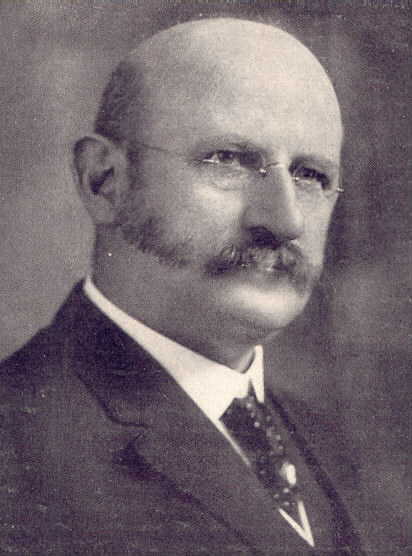
For the past five years I
enjoyed confidential relations, both professionally and personally,
with our deceased fiend, and a sufficient intimacy that I shared
innumerable midday meals
with him at his home. Our last meal together was not three hours
before
his fatal mishap, and at that meal he produced a paper from his pocket
--
which the day before he had also shown to the secretary to Mr. F. B.
Bonfils
- and on which he had written, with his own hand, what he had early in
life understood to be the golden thread running through the life and
conduct
of Abraham Lincoln, therein also stating how his own aim had been to
emulate the rule or principle that made the thread golden, and which --
after he
should be no more -- he hoped that all his community might understand.
That now appears to have been a prophetic shadow cast just before
the oncoming need, and it therefore seems a fitting and proper
extension of his own wishes that here -- where we have met as a mark of
respect and tribute to the departed friend and benefactor of this city
and state -- I should make some short
pronouncement typical of the life and great character of him we mourn.
In the accepted Christian belief, Mr. Kindel has
merely laid aside his surging labors to enjoy their fruits.
The result of those labors, in the public mind, may,
perhaps, appear mainly as the denial of political supremacy for Mr.
Kindel's preachments, but such denial does happen at times to
distinguish great men. I shall not allude further to his ruling
passion than to say it is true
that powerful selfish interests therefor never ceased to dig a vast pit
for
him, and it is not less true that the electorate usually helped with
some
zeal without at all considering the truth in that ancient proverb which
says:
"Beware how thou diggest a pit for another, let you fall into it
thyself."
His understanding was that the guiding principle of
Abraham Lincoln's life was to do and to say the
right,
regardless
of the odds or consequences; speaking the
truth at all events.
Towards
this end he said that he had often done many things which induced
"fights"
he would have preferred to avoid, and this appeared to him to have been
most
true in respect of public matters. He understood that Lincoln
belonged
to no church and said that the results of his own aim at Lincoln's
ideal
was about all the religion he had, adding that he was not ashamed of it.
I now repeat that his own words were "to do and to
say the
right, regardless of the odds or consequences."
That rule of immutable law, of itself, is alone sufficient for a
man of good understanding if he has the resolute courage to so govern
himself, and, in the preaching of universal law "enforcement" today it
is monumental to note that him we mourn carried the immutable law
around with him, and that explains why no man's power, position or
wealth could ever quail his spontaneous and fearless use of that rule,
without stint or deviation of any kind. Thus the
chiefest elements of honesty, right and courage were so planted in his
heart
by he Finger of his Maker that one might stand up and say to all the
world:
"This was a man."
To illustrate his own private use of the immutable
law just mentioned -- and that best shows the character of the man -- I
trust that I may be permitted to trespass here to relate to you a story
as I related it to him one Monday morning in January last, when Mr.
Kindel had visited my office at an unusually early hour, because [he
was] feeling unwell and dispirited at the vanity of life. A
Scottish Rite masonic friend of mine happened to be present at that
time.
After repeating to him what a railroad lawyer had
said of him some days before -- and it had been intended as an
estimate, without
flattery -- I continued:
"Of course you do know about the
temptress who visited you in Washington at the height of your express
rate fight, even though do not know who sent her, but you never knew
what I am going to tell you now.
"A certain powerful factor in the political life of
this city with whom you once clashed on a public matter was thereafter
discussing you and your character with a friend when he said:
"`Well, whatever else we think about Kindel, we are
compelled to admit that all his acts are honest, sincere and
incorruptible. I know. I tried him. But Kindel don't
know that I tried him.'"
Mr. Kindel's eyes really glistened as he asked: "Mr.
Bosley, who was that man?" I told him. His eyes widened and
then
he remarked: "I now see why in his late life that man's
cordiality
seemed to say that I had deserved better than I had gotten, and it
explains
some other things his widow has said to me, too." Then, saying,
"Well,
Bosley, perhaps my life has been not in vain after all." and that he
had
never won more gratification in any victory than what had just been
told
him, he left the office with renewed hope to make renewed effort, to
the
very day of his mishap, as I know.
Of course the virtue we see in others is as much
ours as theirs, for we see only so much as we possess, and be it said
that his tempter -- who himself had a very human side and really a
great heart -- had,
ever so clearly and almost solely, seen Kindel actually carrying the
immutable
law under his own hat, in secret just as he professed it in public.
I
refer to that law which Antigone expressed as "those unfailing mandates
which
are not of today or yesterday, but ever live, and no one knows their
birthtide."
Now, when the immutable law was first reduced to
written form and carried down from Mount Sinai for the better use of
the brotherhood of man, Holy Writ tells us that "Moses wist not that
his face shone," and behold! Mr. Kindel wist not that the face of
his incorruptible integrity shone with that "great wakening light" and
resplendent grandeur which found admiration in the soul of his
adversary to help exalt him!
The victories of peace are not less renowned than
those of war, and than this enduring victory of Mr. Kindel over the
turbulent warrior with whom he contended, there is none higher.
Such a pattern, unique in type, can of course only be found in a
man truly great!
I speak not of intellect, or learning, which
sometimes is said to polish pebbles and dim diamonds, but if this
community affords a character higher than that of him we mourn, it is
my misfortune to be ignorant of it. And I only wish that the
youth of our high schools today might understand -- and to be taught,
if that were possible -- the imperishable foundation of such a great
character. Moreover, I can testify to a wish
of his to be of advantage and benefit to high school students, as
Governor Adams and the State superintendent of Public Instruction can
also testify. A letter written for him by Governor Adams during
the week of his death, though under a heavy rubber band with other
papers beside him just before the wreck, was, with the ditch mud
plainly on one side of it, found in his outside overcoat pocket
afterwards. This shows the strength, unto death, of his cherished
aims for the public weal.
The Denver Post has said, and it has well
said, that if this community had more men of Mr. Kindel's type it would
be much better off. But, realizing full well the truth in the
assertion that the "authority of religion is superior to all other
authority," I say, and I say it constructively, that even if some of
the ministers of the gospel with us had the noble roughness of George
J. Kindel's fearless truth at all times, though they uttered it as he
shed it, without its being obscured by varnish of any kind, or tact, we
should indeed have a community of wonderful excellence!